Owls always stir a sense of wonder. I keep my distance, careful not to disturb them, but each sighting feels like a gift. This one took several attempts before I managed a proper photograph.
The first time, a passerby noticed my long lens and told me an owl was perched ahead. I scanned the trees, searching cavities and branches, until I spotted a likely roost. The tree stood well off the path, so I raised my camera to check. Through the lens, I saw him — a quick shot in my excitement. Reviewing the image, I realized auto ISO had jumped to 25,600. A record shot, nothing more. By the time I adjusted settings, he had slipped back into his hole.
On another morning, overcast and quiet, I returned. Nearing the spot, I lifted my camera. Luck was with me: the owl sat on a branch, eyes closed. I set up my tripod, mindful of the dim light and slow shutter speed. As I adjusted the height, I looked back — and he was gone.
Later, I left work early to beat traffic and reach the site before dusk. At first, no owl. Coyotes howled nearby, but stayed hidden. I left looking to find the coyotes. Returning to the roost, I found him low in the cavity, asleep. I set ISO to 500, slowed the shutter to three seconds, and waited. He opened his eyes, and I captured the moment. The photo is below.
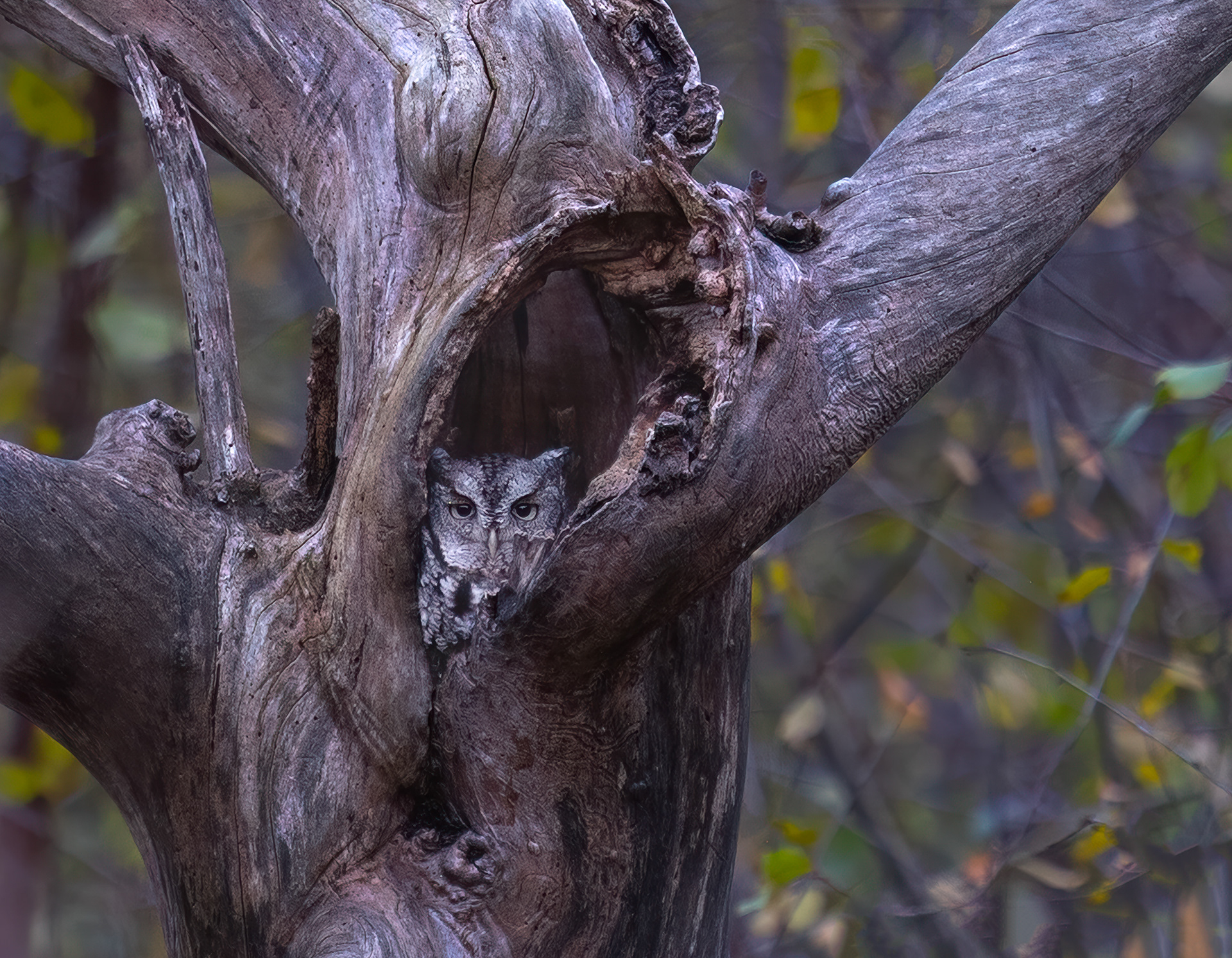
As darkness deepened, still photography became impossible. I switched to video, a newer pursuit for me. Fifteen minutes of footage in nautical twilight became a short sequence. Harsh transitions remain where sections were removed, but I adjusted exposure so his movements could be seen. Without the camera, he was invisible in the gloom. The video is below.